
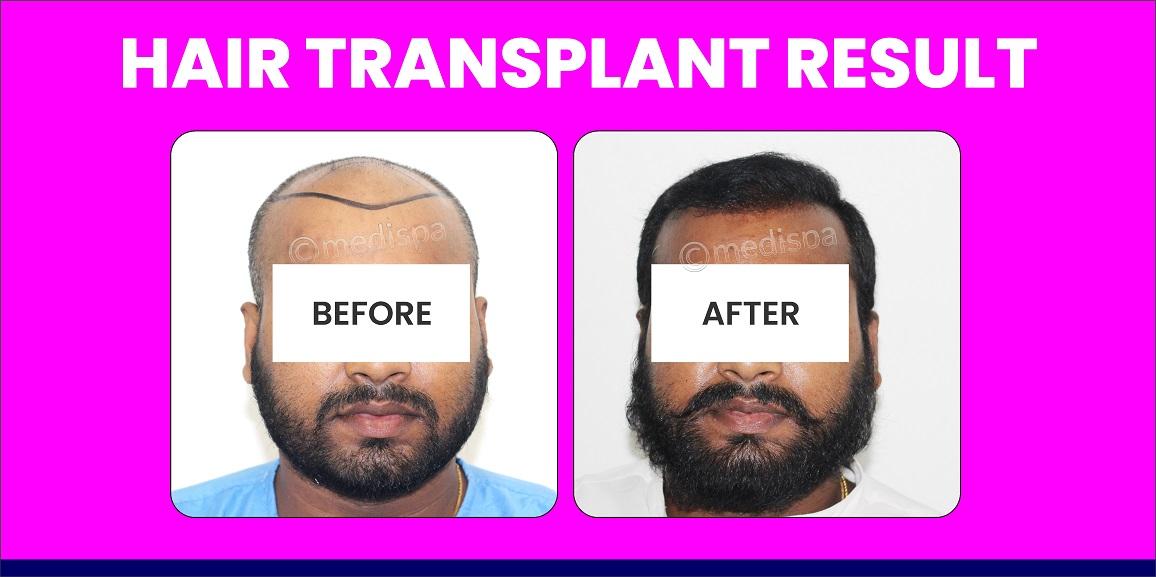
If you are looking into a hair transplant, one of the obvious questions that anybody would ask is How many grafts am I going to need to recreate my hairline? It is a super-important question and the simple fact is, the answer is not the same for every person. The more hair that you have lost, the higher the number of grafts you will require. But it is not a matter of how much hair is lost. Your current density of hair, hair type (thin or thick), area size you want covered, and your hoped-for future loss of hair all come into play equally in the graft calculation.
In this blog, we will help you to understand more about hair graft calculation and hair transplant in Delhi so that you can be assured and completely aware before making a decision. You will know exactly what a hair graft is, how the overall number of grafts is determined, and how much the average cost per graft is, so you can budget accordingly.
How Many Hair Grafts Are Required
When you are initially researching a hair transplant, this is typically the most frequent (and most significant) question: How many grafts am I going to need to restore my hairline? It sounds simple, but it is not the same number for every person, since every person has different hair and genetics.
Generally, small regions of recession (such as the temples) can frequently be hidden with a few hundred grafts, whereas full reconstruction of a receding crown or hairline can take a few thousand grafts.
But a skilled surgeon does not use guesswork or averages. They will measure the thickness of your current hair, the density of your donor area, the balding pattern of your head, and even your future balding potential before computing a correct graft number.
This customised number helps in 2 things–
1) you won’t waste valuable grafts, and
2) Your outcome appears entirely natural and harmonises flawlessly with the remainder of your hair.
A brief consultation is usually all it takes to provide you with an accurate hair graft calculation and finally, peace of mind before proceeding.
How to Calculate Your Hair Graft Need
Calculating the total number of grafts required should not be guesswork, it is a structured process based on a few core factors. First, your hair transplant surgeon will assess how much hair you have already lost, which is typically determined using the Norwood Scale. This gives an initial estimate of the number of grafts needed for the areas affected so far.
Then they will determine the speed at which your hair continues to thin, because if you have hair loss, then covering up the existing losses can not be a lasting solution. That’s why anticipated hair loss in the future is also considered.
To simplify it, the scalp is categorised into various zones (like frontal hairline, mid-scalp, crown etc.), and each zone will need a different quantity of grafts based on how big it is and how dense it needs to be.
What Is the Safe Donor Area?
When it comes to preparing for a hair transplant in Delhi, it is very important to recognise that not every hair on your scalp can be transplanted. It is only hair that falls inside the safe donor area. This is the area (typically at the sides and back of the scalp) where follicles are genetically immune to balding and are thus ideal for long-term outcomes.
- The safe donor region has limitations and surgeons can only take a certain number of grafts without risking thinning and gaps that can be seen.
- Age is relevant, as some studies have established that the safe donor region may gradually reduce as you age.
- Not all patients can remove 6,000+ grafts safely, some who have bigger donor areas will qualify, but this is not the norm.
- No more than 25% of the follicles should be harvested in one session, taking more than this risks overharvesting and a patchy appearance.
This is why it is important to select a surgeon who undertakes a proper evaluation and provides a realistic graft estimate. Watch out for clinics that offer excessively high graft totals. A good policy will always keep the long-term health of your donor area.
How Many Grafts Can Be Taken at One Time?
For most patients, 2000 to 3,000 grafts is the maximum safe number for a single session of transplanting. With this number, the surgical team is able to remove and implant grafts with accuracy, while still having sufficient blood supply to the scalp and protecting nearby tissue from damage. For patients who have a big healthy donor area can be taken slightly more than 2,500–3,000 grafts, but even then, it is always individually evaluated.
If you require more grafts to get your optimal outcome, the procedure is typically broken down into several sessions. This allows your scalp to heal completely between procedures (usually 12 months), so more grafts can be safely inserted between previous ones. By doing this, your overall density can be greatly increased over a period.
How Many Hair Transplant Grafts Will I Need?
The amount of grafting required to achieve your hair restoration results is directly related to the size of the thinning area you wish to address and the level of desired density.
These estimates serve as a realistic guideline and inform you about what is achievable in terms of coverage. An individualised hair graft calculation will adjust these figures to ensure that the results are in line with your expectations and visual aspirations.